The Only Time You Can Drive on a Sidewalk Is

Raised sidewalk beside a 2000-year-old paved route, Pompeii, Italia
A sidewalk (Due north American English),[one] pavement (British English),[two] footpath (Oceanian English), or footway, is a path along the side of a road. Unremarkably constructed of concrete or cobblestone, information technology is designed for pedestrians.[3] A sidewalk may suit moderate changes in grade (elevation) and is normally separated from the vehicular section by a curb (spelled "kerb" exterior North America). There may besides be a median strip or road verge (a strip of vegetation, grass or bushes or trees or a combination of these) either between the sidewalk and the roadway or between the sidewalk and the boundary.
In some places, the same term may also be used for a paved path, trail or footpath that is not side by side to a route, for example, a path through a park.
Terminology [edit]
The term "sidewalk" is preferred in most of Northward America.[1] The term "pavement" is more than mutual in the Britain[iv] and other members of the Commonwealth of Nations, too as parts of the Mid-Atlantic United states such as Philadelphia and parts of New Jersey.[5] [6] Many Commonwealth countries utilise the term "footpath". The professional, ceremonious engineering and legal term for this in N America is "sidewalk" while in the U.k. it is "footway".[7]
In the United states of america, the term sidewalk is used for the pedestrian path beside a road. "Shared use paths" or "multi-utilise paths" are bachelor for use by both pedestrians and bicyclists.[eight] "Walkway" is a more comprehensive term that includes stairs, ramps, passageways, and related structures that facilitate the apply of a path too every bit the sidewalk.[9] In the United kingdom of great britain and northern ireland, the term "footpath" is generally used for paths that do not abut a roadway.[10] The term "shared-utilize path" is used where cyclists are besides able to utilise the same section of path as pedestrians.[xi]
History [edit]
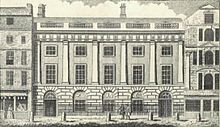

Raised wooden sidewalk by a dirt road, Staten Island, Due north.Y., early 20th century
Sidewalks accept operated for at to the lowest degree 4000 years.[12] The Greek metropolis of Corinth had sidewalks by the 4th-century BC, and the Romans congenital sidewalks – they chosen them sēmitae.[13] [14]
However, by the Centre Ages, narrow roads had reverted to being simultaneously used past pedestrians and wagons without any formal separation between the 2 categories. Early on attempts at ensuring the adequate maintenance of foot-ways or sidewalks were oft fabricated,[ why? ] equally in the 1623 Deed for Colchester, but they were more often than not not very constructive.[15]
Post-obit the Great Fire of London in 1666, attempts were slowly made[ by whom? ] to bring some guild to the sprawling city. In 1671, 'Sure Orders, Rules and Directions Touching the Paving and Cleansing The Streets, Lanes and Common Passages inside the City of London' were formulated, calling for all streets to exist fairly paved for pedestrians with cobblestones. Purbeck stone was widely used as a durable paving material. Bollards were also installed to protect pedestrians from the traffic in the heart of the road.
The British House of Commons passed a serial of Paving Acts from the 18th century. The 1766 Paving & Lighting Act authorized the City of London Corporation to found pes-ways throughout all the streets of London, to pave them with Purbeck stone (the thoroughfare in the eye was more often than not cobblestone) and to raise them above the street level with kerbs forming the separation.[16] The Corporation was also made responsible for the regular upkeep of the roads, including their cleaning and repair, for which they charged a taxation from 1766.[17] Another turning point was the structure of Paris'southward Pont Neuf (1578-1606) which fix several trends including broad, raised sidewalks separating pedestrians from the road traffic, plus the first Parisian span without houses congenital on it, and its generous width plus elegant, durable blueprint that immediately became popular for promenading at the start of the century that saw Paris take its grade renown to this day. It was also a cultural phenomenon because all classes mixed on the new walkways. By the 19th-century large and spacious sidewalks were routinely synthetic in European capitals, and were associated with urban sophistication.
In the United States, adjoining belongings owners must in most situations finance all or office of the cost of sidewalk construction. In a legal instance in 1917 involving E. 50. Stewart, a onetime member of the Louisiana House of Representatives and a lawyer in Minden in Webster Parish, the Louisiana Supreme Court ruled that owners must pay whether they wish for the sidewalk to be constructed or non.[18]
Benefits [edit]
Transportation [edit]

Pedestrians walking on the sidewalk, locally known every bit a "pavement" in London.
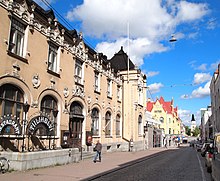
Sidewalk at Kauppakatu in Tampere, Republic of finland.
Sidewalks play an important office in transportation, equally they provide a rubber path for people to walk along that is separated from the motorized traffic. They aid road safety by minimizing interaction between pedestrians and motorized traffic. Sidewalks are normally in pairs, one on each side of the road, with the centre department of the road for motorized vehicles.
In rural roads, sidewalks may non exist present as the amount of traffic (pedestrian or motorized) may not be enough to justify separating the ii. In suburban and urban areas, sidewalks are more common. In boondocks and city centers (known equally downtown in North America) the corporeality of pedestrian traffic can exceed motorized traffic, and in this example the sidewalks can occupy more than half of the width of the road, or the whole road can be reserved for pedestrians, see Pedestrian zone.
Environment [edit]
Sidewalks may take a small consequence on reducing vehicle miles traveled and carbon dioxide emissions. A study of sidewalk and transit investments in Seattle neighborhoods constitute vehicle travel reductions of 6 to 8% and CO2 emission reductions of one.3 to 2.2%[19]
Road traffic safety [edit]
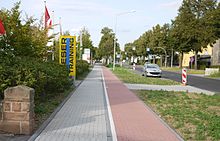
Research deputed for the Florida Section of Transportation, published in 2005, found that, in Florida, the Crash Reduction Factor (used to judge the expected reduction of crashes during a given period) resulting from the installation of sidewalks averaged 74%.[20] Research at the University of Due north Carolina for the U.Due south. Department of Transportation found that the presence or absence of a sidewalk and the speed limit are significant factors in the likelihood of a vehicle/pedestrian crash. Sidewalk presence had a risk ratio of 0.118, which means that the likelihood of a crash on a route with a paved sidewalk was 88.2 percentage lower than one without a sidewalk. "This should not exist interpreted to mean that installing sidewalks would necessarily reduce the likelihood of pedestrian/motor vehicle crashes by 88.ii percent in all situations. Notwithstanding, the presence of a sidewalk clearly has a strong benign outcome of reducing the risk of a 'walking along roadway' pedestrian/motor vehicle crash." The study does not count crashes that happen when walking across a roadway. The speed limit chance ratio was one.116, which ways that a 16.one-km/h (10-mi/h) increment in the limit yields a factor of (1.116)10 or 3.[21]
The presence or absence of sidewalks was i of three factors that were plant to encourage drivers to choose lower, safer speeds.[22]
On the other hand, the implementation of schemes which involve the removal of sidewalks, such as shared space schemes, are reported to deliver a dramatic drib in crashes and congestion as well, which indicates that a number of other factors, such as the local speed environment, too play an important role in whether sidewalks are necessarily the best local solution for pedestrian condom.[23]
In cold weather, black ice is a common problem with unsalted sidewalks. The water ice forms a thin transparent surface motion-picture show which is near impossible to run across, and then results in many slips by pedestrians.
Riding bicycles on sidewalks is discouraged since some research shows it to be more than dangerous than riding in the street.[24] Some jurisdictions prohibit sidewalk riding except for children. In improver to the risk of cyclist/pedestrian collisions, cyclists face increase risks from collisions with motor vehicles at street crossings and driveways. Riding in the direction reverse to traffic in the side by side lane is especially risky.[25]
Health [edit]
Since residents of neighborhoods with sidewalks are more likely to walk, they tend to have lower rates of cardiovascular illness, obesity, and other health issues related to sedentary lifestyles.[26] As well, children who walk to school have been shown to accept improve concentration.[27]
[edit]

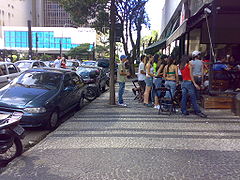
Some sidewalks may be used as social spaces with sidewalk cafes, markets, or busking musicians, as well as for parking for a diverseness of vehicles including cars, motorbikes and bicycles.
Construction [edit]
Contemporary sidewalks are most often fabricated of physical in North America, while tarmac, asphalt, brick, rock, slab and (increasingly) rubber are more mutual in Europe.[28] Unlike materials are more than or less friendly environmentally: pumice-based trass, for case, when used as an extender is less energy-intensive than Portland cement concrete or petroleum-based materials such as cobblestone or tar-penetration macadam. Multi-use paths alongside roads are sometimes fabricated of materials that are softer than physical, such every bit asphalt.
Wood [edit]
In the 19th century and early on 20th century, sidewalks of wood were common in some North American locations. They may nonetheless exist found at historic beach locations and in conservation areas to protect the land beneath and effectually, called boardwalks.
Brick [edit]

Virtually sidewalks in Cambridge, Massachusetts are made of brick, formerly locally produced
Brick sidewalks are found in some urban areas, usually for aesthetic purposes. Brick sidewalks are generally consolidated with brick hammers, rollers, and sometimes motorized vibrators.

Stone [edit]

Stone slabs chosen flagstones or flags are sometimes used where an bonny appearance is required, as in historic town centers.
For example, in Melbourne, Commonwealth of australia, bluestone has been used to pave the sidewalks of the CBD since the Gilded Rush in the 1850s because information technology proved to be stronger, more plentiful and easier to work than about other available materials.[29]
Stone and concrete pavers [edit]
Pre-cast concrete pavers are used for sidewalks, oft colored or textured to resemble stone. Sometimes cobblestones are used, though they are generally considered also uneven for comfortable walking.
-

Installation of crushed stone underlayment for drainage
-

Installation of paver blocks
Concrete [edit]

Freshly laid concrete sidewalk, with horizontal strain-relief grooves faintly visible
In the United States and Canada, the nigh common type of sidewalk consists of a poured concrete ribbon, examples of which from equally early on as the 1860s tin can be institute in good repair in San Francisco, and stamped with the proper noun of the contractor and date of installation.[ citation needed ] When Portland cement was first imported to the United states of america in the 1880s, its master employ was in the structure of sidewalks.[thirty]
Today, virtually sidewalk ribbons are synthetic with cantankerous-lying strain-relief grooves placed or sawn at regular intervals typically 5 feet (ane.5 m) apart. This partitioning, an improvement over the continuous slab, was patented in 1924 past Arthur Wesley Hall and William Alexander McVay, who wished to minimize harm to the concrete from the effects of tectonic and temperature fluctuations, both of which can crack longer segments.[31] The technique is not perfect, as freeze-thaw cycles (in common cold-atmospheric condition regions) and tree root growth can somewhen result in harm which requires repair.
In highly variable climates which undergo multiple freeze-thaw cycles, concrete blocks will be formed with separations, called expansion joints, to allow for thermal expansion without breakage. The employ of expansion joints in sidewalks may not be necessary, equally the concrete will compress while setting.[32]
Tarmac and asphalt [edit]
In the Uk, Australia and French republic suburban sidewalks are most unremarkably synthetic of tarmac. In urban or inner-city areas sidewalks are most commonly constructed of slabs, stone, or brick depending upon the surrounding street compages and furniture.
Gallery [edit]
-
-

-

-
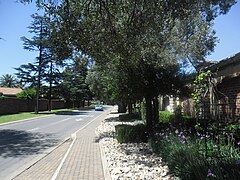
-

-
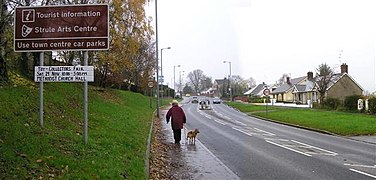
-

"Sidewalk closed" sign in Miami Beach urges crossing street to other sidewalk
-

-

-
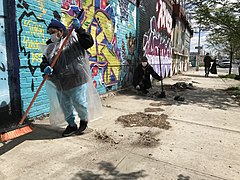
Sidewalk covered in dirt and grit, is cleaned during a street clean-up in Brooklyn, NYC
Meet also [edit]
- Amsterdammertje
- Large Apple Pothole and Sidewalk Protection Committee
- Café
- Carwalking
- Cobblestone
- Crosswalk
- Curb
- Curb ramp
- Desire path
- Flagstone
- Median strip
- Moving walkway
- Pavement
- Portuguese pavement
- Public space
- Sidewalk chalk
- Street furniture
References [edit]
- ^ a b "Definition of SIDEWALK". www.merriam-webster.com. Merriam-Webster. Retrieved 2020-10-25 .
- ^ "pavement". www.oxfordlearnersdictionaries.com. Oxford University Printing. Retrieved 2020-10-25 .
- ^ Caves, R. W. (2004). Encyclopedia of the City. Routledge. p. 594. ISBN9780415252256.
- ^ "Parking on pavements". Lewisham Council. Archived from the original on 2010-x-04. Retrieved 2010-10-29 .
Why is pavement parking a problem? Pavements are constructed and provided for pedestrian use. Vehicles parked on pavements are: a gamble to pedestrians causing an obstruction which may result in them having to step off the pavement onto the highway thus putting themselves in danger...
- ^ Cassidy, Frederic Gomes, and Joan Houston Hall (eds). (2002) Dictionary of American Regional English language. Cambridge, MA: Harvard University Press.
- ^ Allan A. Metcalf (2000). How Nosotros Talk: American Regional English Today . Houghton Mifflin Harcourt. p. 90. ISBN0-618-04362-iv.
- ^ "Highways Act 1980 – Estimation Section 329". Archived from the original on 2011-02-06.
"footway" means a way comprised in a highway which as well comprises a carriageway, existence a way over which the public have a right of fashion on pes merely
- ^ "Part 2 of Two: All-time Practices Design Guide - Sidewalk2 - Publications - Bicycle and Pedestrian Program - Environment - FHWA". world wide web.fhwa.dot.gov. Archived from the original on 2011-xi-29.
- ^ "Walkway". Compact Oxford English Lexicon.
- ^ "Inclusive mobility". Section for Ship. Archived from the original on 2010-11-22. Retrieved 2010-04-02 .
The distinction betwixt a footway and a footpath is that a footway is the part of a highway side by side to, or contiguous with, the roadway on which there is a public right of way on pes. A footpath is non next to a public roadway. Where reference is made to 1, it can generally exist regarded equally applying to the other for design purposes
{{cite spider web}}: CS1 maint: bot: original URL status unknown (link) - ^ "Highways Act 1980 – Interpretation Section 329". Archived from the original on 2011-02-06.
"cycle track" ways a style constituting or comprised in a highway, being a way over which the public have the following, but no other, rights of way, that is to say, a right of style on pedal cycles [F3 (other than pedal cycles which are motor vehicles within the meaning of F4 the Route Traffic Human action 1988 with or without a correct of way on pes
- ^ Anastasia Loukaitou-Sideris, Renia Ehrenfeucht (2009). Sidewalks: Disharmonize and Negotiation Over Public Infinite. MIT Press. p. xv. ISBN9780262123075 . Retrieved 18 Nov 2018.
The first sidewalks appeared around 2000 to 1990 B.C. [...] in key Anatolia (modern Turkey) [...].
- ^ Anastasia Loukaitou-Sideris, Renia Ehrenfeucht (2009). Sidewalks: Conflict and Negotiation Over Public Space. MIT Press. p. 15. ISBN9780262123075.
- ^ https://en.wiktionary.org/wiki/semita#Latin semita
- ^ "Georgian Colchester". British History. Archived from the original on 2011-12-28. Retrieved 2010-04-05 .
Bad paving and obstructions were oft reported to the justices under a paving Human activity of 1623, simply the civic chamberlain, workhouse corporation, and parish officers failed to belch their responsibilities and the small fines for fail were ineffective. Enforcement of the Deed by the borough justices ceased when the charter lapsed in 1741 and by 1750 the streets were and then ruinous that a new Deed was obtained, which perpetuated the responsibility of justices to enforce the regulations.
- ^ Linda Clarke (2002). Edifice Commercialism (Routledge Revivals): Historical Change and the Labour Procedure in the Production of Built Environs. Routledge. p. 115. ISBN9781136599538.
- ^ "metropolis street scene transmission" (PDF). Archived from the original (PDF) on 2013-12-15. Retrieved 2012-12-17 .
- ^ Boondocks of Minden v. Stewart et al. Southern Reporter, Vol. 77. Nov 26, 1917. pp. 118–121. Retrieved March 13, 2015.
- ^ "Research Note: An Assessment of Urban Form and Pedestrian and Transit Improvements as an Integrated GHG Reduction Strategy" (PDF). Washington Country Section of Transportation. April 2011. Archived (PDF) from the original on 2013-06-18.
- ^ Gan, Albert; Joan Shen; Adriana Rodriquez (2005). "Update of Florida Crash Reduction Factors and Countermeasures to Meliorate the Development of District Safety Improvement Projects" (PDF). State of Florida DOT. BD015-04. Archived (PDF) from the original on 2008-04-10. Retrieved 2008-03-24 .
- ^ McMahon, Patrick J.; Charles V. Zegeer; Chandler Duncan; Richard L. Knoblauch; J. Richard Stewart; Asad J. Khattak (2002). "AN Analysis OF FACTORS CONTRIBUTING TO "WALKING ALONG ROADWAY" CRASHES, Enquiry STUDY AND GUIDELINES FOR SIDEWALKS AND WALKWAYS" (PDF). Federal Highway Administration. FHWA-RD-01-101. Archived (PDF) from the original on 2008-04-10. Retrieved 2008-03-24 .
- ^ John Due north. Ivan, Norman Westward. Garrick and Gilbert Hanson (Nov 2009). DESIGNING ROADS THAT GUIDE DRIVERS TO CHOOSE SAFER SPEEDS. Connecticut Transportation Institute.
- ^ "Do you lot take unnecessary risks backside the wheel?". Which?. 2011-01-05. Archived from the original on 2012-03-12. Retrieved 2011-01-27 .
The town of Drachten removed most of its street furniture, signs and markings in 2003 and recorded a dramatic fall in accidents and traffic congestion as a upshot
- ^ Lisa Aultman-Hall and Michael F. Adams, Jr. (1998). "Sidewalk Bicycling Safety Issues". Transportation Research Tape (1636).
- ^ "Bicycle sidepaths: Crash risks and liability exposure: Bear witness from the research literature". eight December 2010. Archived from the original on 11 September 2011. Retrieved 2011-09-17 .
- ^ "Crimes of the Heart". The Daily Beast. Archived from the original on August 10, 2013. Retrieved February vi, 2013.
- ^ "The Link Between Kids Who Walk or Bicycle to Schoolhouse and Concentration". The Atlantic Cities. Archived from the original on February vii, 2013. Retrieved February 6, 2013.
- ^ Webster, George (2011-10-thirteen). "Green sidewalk makes electricity one footstep at a fourth dimension". CNN.
- ^ "Stone & Slate Discounts Learning Library". Why Bluestone is Melbourne's Most Pop Paving Stone.
{{cite spider web}}: CS1 maint: url-status (link) - ^ Robert Westward. Lesley. "What Cement Users Owe To The Public". The Cement Age: A Magazine Devoted to the Uses of Cement. 2 (9): 652.
- ^ Mario Theriault, Dandy Maritime Inventions – 1833–1950, Goose Lane Editions, 2001, p. 73
- ^ "Archived copy". Archived from the original on 2014-05-21. Retrieved 2014-05-21 .
{{cite web}}: CS1 maint: archived copy equally title (link)
External links [edit]
 | Wikimedia Commons has media related to Sidewalks. |
- Los Alamos Walkability Advocacy Group
- PEDS a member-based advocacy grouping dedicated to making metro Atlanta safe and accessible for all pedestrians.
- Pedestrian and Bike Data Heart (PBIC), a United states of americaA.-based clearinghouse for information for pedestrians (including transit users) and bicyclists.
- Manifesto for the Reorganisation of the City after COVID19, a radical proposal for the post-COVID city published in Barcelona on 20 April 2020. Author: Massimo Paolini.
Source: https://en.wikipedia.org/wiki/Sidewalk

Post a Comment for "The Only Time You Can Drive on a Sidewalk Is"